
Kinabalu Climb Part 2 🧗♀️ Summit Push & Descent
The reality of Borneo’s Mount Kinabalu, we discovered, lies not in the triumphant photographs taken at dawn, but in the pitch-black, exhausting hours preceding them, and the subsequent descent.
If day one to basecamp is a leisurely climb ending with a decent buffet, day two begins with a brutal, sharp, and very cold slap across the face.
Highlights
- 1st Day: Before the Summit Push
- Low’s Peak 🌙🌅 2nd Day Ascent
- The Descent 🤕☔️📉
- Post-Climb Conundrums 🌡️
- Recovery 🛀 at the Shangri-La
- What We Dragged Up the Mountain
- The Cocktail 🍹 of Commemoration
- Our Kinabalu ‘Warm-Up’ Act 🧗♀️
- A Kinabalu Cartoon Extravaganza!
- Book a Climb with Amazing Borneo
- Useful Hiking & Climbing Gear
- Flights from KL to Kota Kinabalu
- All Hotel Deals in Kota Kinabalu
- Experiences 🌟 Not Sightseeing
- Our Complete Borneo Itinerary
Low’s Peak 🌙🌅 2nd Day Ascent
We’d endured a night of fitful, anxious sleep, hyper-aware that the 01:15 am alarm was the starting pistol for our personal race against oxygen deprivation. We had hoped for a clean run, but Kinabalu had other plans.

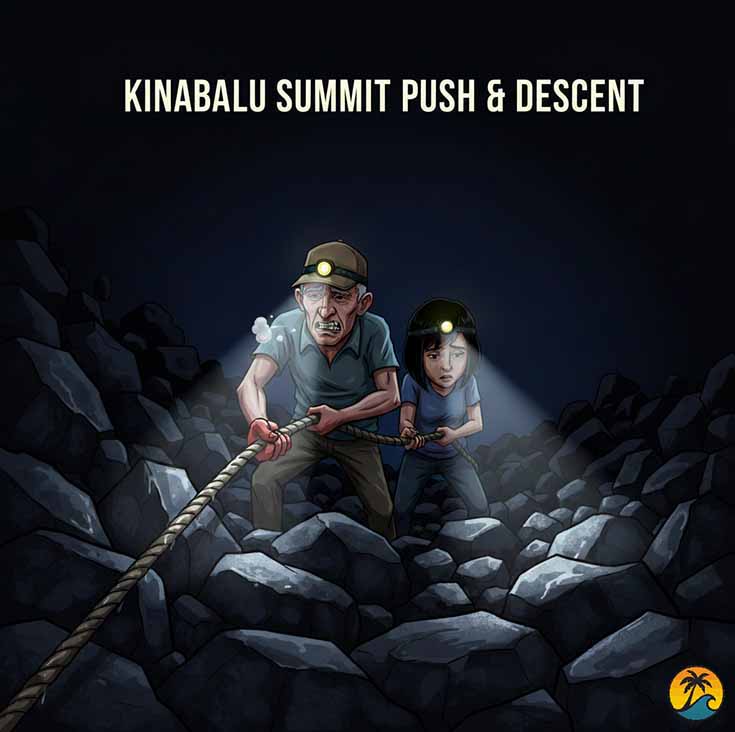
Shivering in the pre-dawn blackness, with thin air filling our lungs and head torches pin-pointing the way up, we knew the real ascent—the vertical, rope-hauling, sanity-testing kind—was finally about to begin.
A light breakfast—tea and jam on bread—and we booted up for the final push. We left our heavier belongings at the hut, ensuring our backpacks were as light as possible.
We set off with Winston just after 2 am, heading up the shadowy trail to Low’s Peak. The weather was mercifully good (no rain), but the trail was immediately steep and uneven. With absolutely nothing to see in the blackness, our world shrank to the small circle of light cast by our head torches, illuminating only the very next step.
After a while, looking behind us, the scene became rather cinematic: a winding trail of bobbing lights snaking up the mountain, following our lead. We were part of the nocturnal, high-altitude parade.
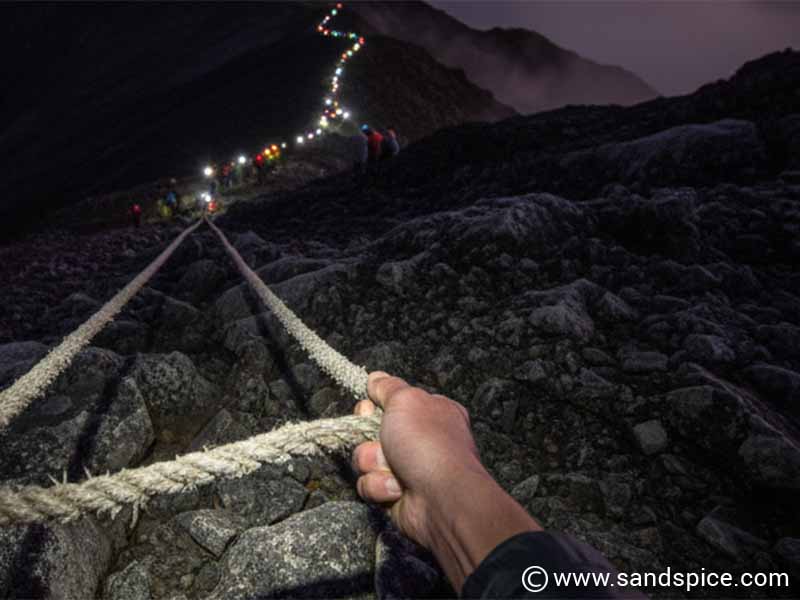
An hour or so in, we reached the rope traverse. From this point, the rope dictated the route. As the incline grew steeper, we found ourselves clinging to it with increasing intensity.
Then, the route turned sharply upwards. Our tracking poles, our trusty friends, were now utterly useless. We needed both hands to haul ourselves vertically up the fixed rope. Winston delivered another pearl of wisdom: no gloves. The rope was wet, and wet gloves at the summit would be hypothermic misery.
We reluctantly agreed, hoping our palms wouldn’t pay the price.

I felt genuinely sorry for Lena, who was struggling up the rope, just above my head. This sort of vertical, arm-straining climb was not what she had envisaged, and it was taking a visible toll. Plus, she has a genuine, bone-deep terror of heights.
The small mercy was the darkness: we had to focus on looking up to pull ourselves, offering little opportunity to look at the sheer drop behind us. And it was too dark to see anything beyond our torch beams anyway.
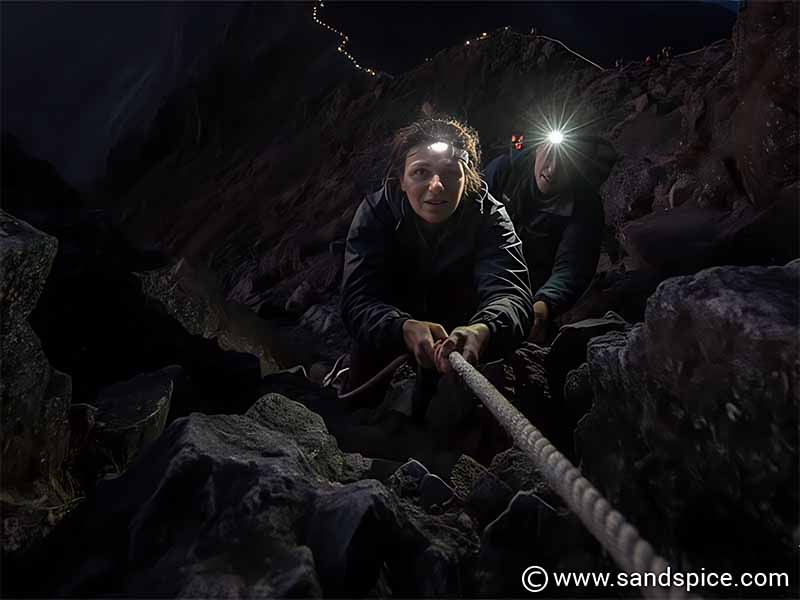
The route zigzagged, always following the fixed rope. Now, it was not merely our legs screaming their objections; our arms were joining the chorus. This continued for another punishing hour until we reached the Sayat Sayat checkpoint hut.
Here, we flashed our climbing permits like we were sneaking into a clandestine party.
Permits approved, we embarked on the final leg. We were still on the rope, but the incline was slightly less aggressive. This was the moment that Lena’s head torch decided to expire. Winston, the prepared gentleman, produced a spare.
Shortly afterwards my own head torch, a cheap piece of kit bought from Temu, also gave up the ghost. To our surprise, Winston had a second spare. He truly was a walking repository of mountaineering readiness. This must, we concluded, happen with alarming regularity.
From here on in, it was a steady, lung-busting grind upwards to Low’s Peak.
It finally became visible, a stark, black silhouette against the nascent pre-dawn sky. A light shone from the peak, an arrogant little beacon indicating that some truly eager climber had already summited.
We were now at approximately 3,900 metres. The oxygen level up here is a paltry 60-70% of what you breathe at sea level. We were breathing deeply, taking twenty steps, then pausing, gasping like a pair of geriatric fish on a riverbank.
But the target was in sight. Stopping now was simply not an option.
It took what felt like an eternity to cover this final distance, slowly passing the lesser peaks of Mount Kinabalu. These slightly less important siblings nevertheless still loomed high above us.
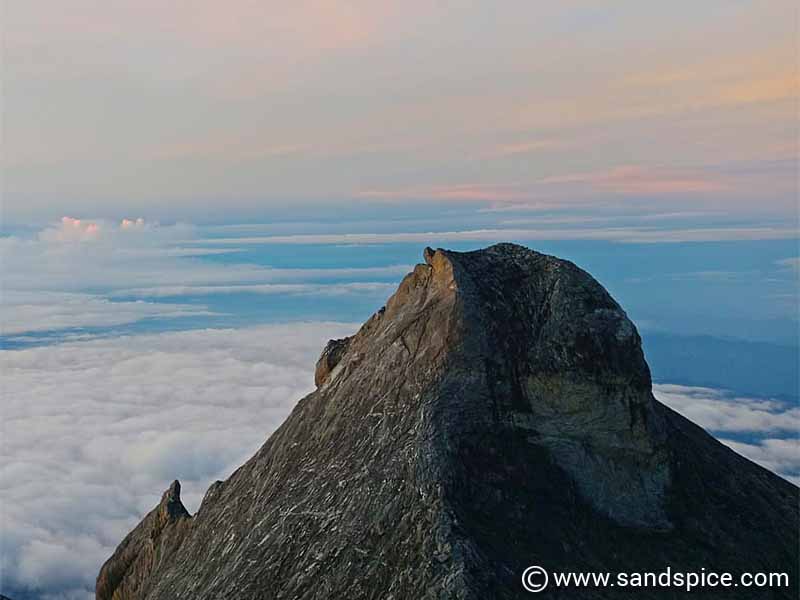
One of Kinabalu’s Lesser Peaks
However, Low’s Peak is the pinnacle: a final, vertical pyramid of granite. It’s a little mountain perched atop the bigger one. When we reached it we had to scramble up the huge boulders using both hands and feet (and the rope).
And then… we were there.
Low’s Peak represents a climb from basecamp with a vertical height of 806 meters over a horizontal distance of 2.72 kilometers. This comprises a gradient of approximately 30%, an angle of incline which is considered very steep and extremely challenging.
Dawn 🌄 Elation or Relief?
Dawn was breaking, painting the sky in a glorious, fiery red hue. We mounted the summit, took the obligatory, slightly wind-battered photos in front of the Peak signpost, and managed a weak, exhausted smile.
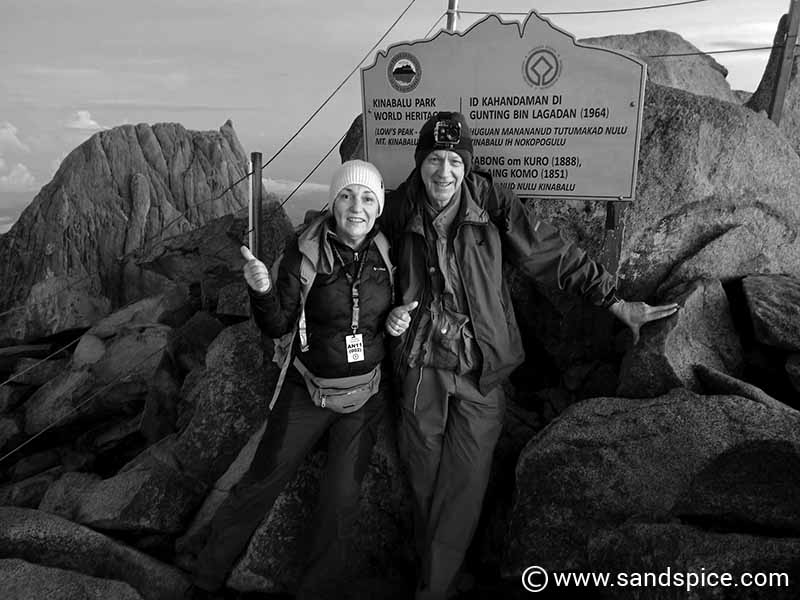
Kinabalu Summit
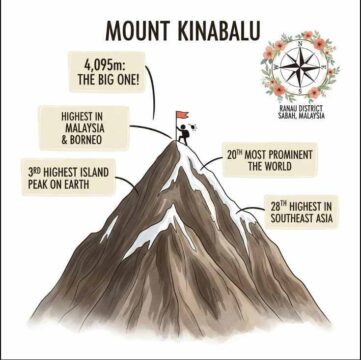
We stood at 4,095.2 metres above sea level—the highest point in all of Malaysia, and the highest we had ever dragged our weary bodies. It was a personal achievement, though when we finally stood on the peak, the dominant emotion was more relief than elation.
It was not long before Winston, acting as the sensible voice of reason, informed us that it was time for the descent. It was nearly 6 am, and we still had an entire mountain to get back down before evening.
It was now light enough to appreciate the stark reality of our position. Just two days prior, we’d been staring up at these peaks, which had seemed impossibly remote. Now, we were here, far above the clouds, looking down on the world like slightly incredulous deities.
The strain, however, was catching up. Lena, in particular, had pushed her body to its limits, injuring her knee and expressing a singular desire: to be horizontal and warm at sea level.
We followed the rope-route back down. In the daylight, the sheer steepness of the drop was now fully visible, but there was only one way to go: down.
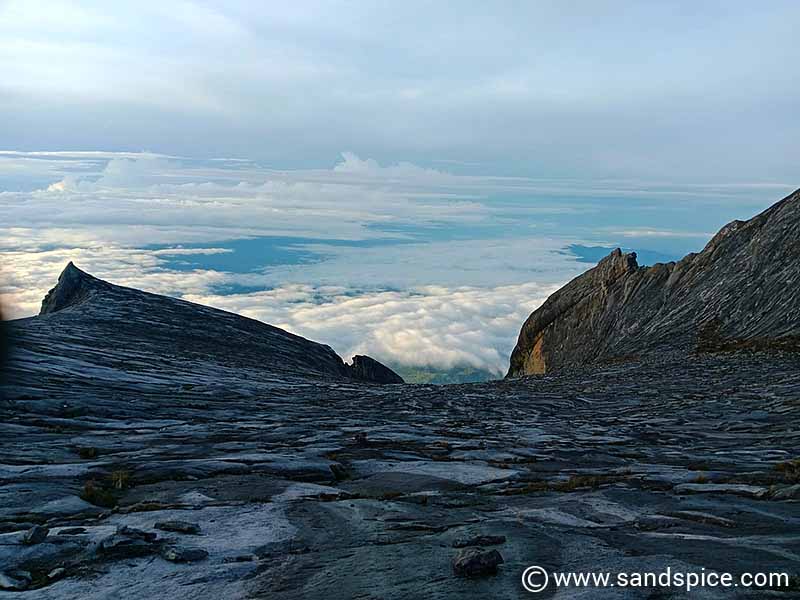
Kinabalu – Descending from the Summit
Via Ferrata ⚖️ A Calculated Retreat
Upon reaching the check-in hut, the moment of truth arrived regarding the Via Ferrata. For Lena, the answer was a categorical, emphatic “No.”
For me? I didn’t want to attempt it without her, and, frankly, I strongly suspected I was running on fumes. I explained our decision to the Via Ferrata guide, who nodded sagely and declared we had made a wise decision.
Little did we know how wise this would truly prove to be. It was, in hindsight, the best decision we’d made all week.
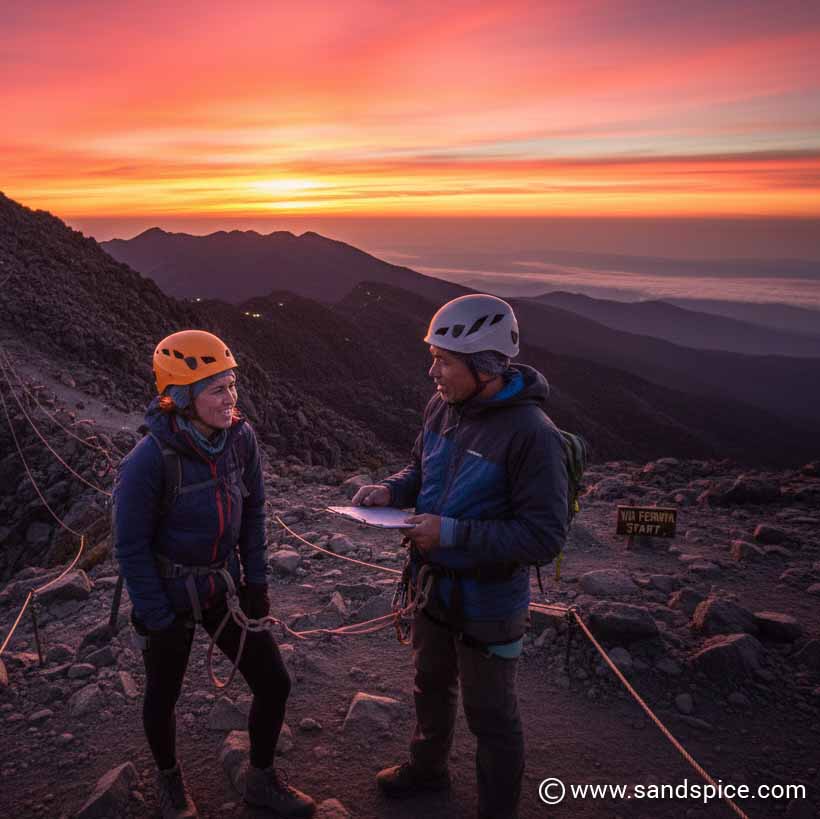
Via Ferrata or not Via Ferrata – That is the Question
The Descent 🤕☔️📉
We descended the final kilometre back to the Pendant Hut for a brief, cold breakfast. We repacked our bags, making them seem impossibly heavy now, and met Winston around 10:30 am for the final descent from basecamp.
Both of us were now experiencing that classic post-climb souvenir: an uncontrollable, internal trembling in our calves, colloquially known as ‘jelly legs’.
We’d experienced this before, after climbing Gunung Raya in Langkawi, and it had been a quirky but transient feeling. What could possibly be different now?
Everything, apparently.
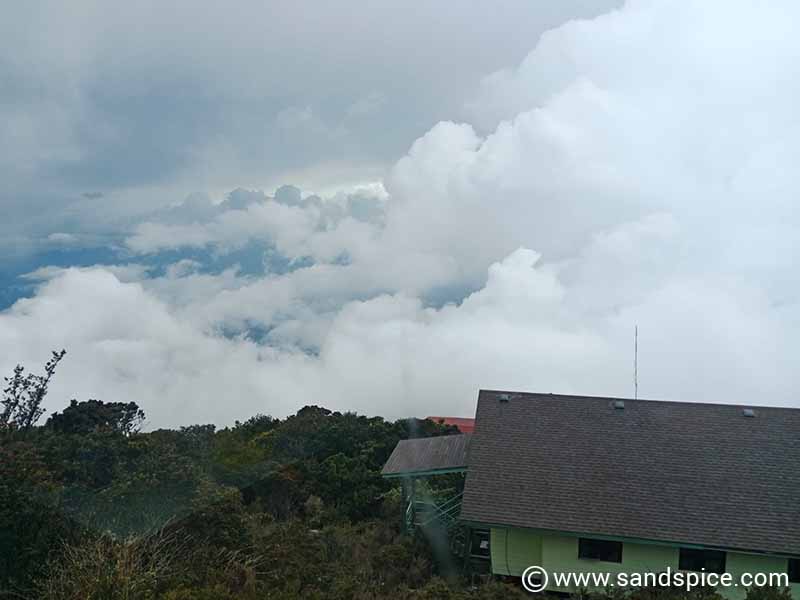
View down from basecamp (weather changing)
As we continued down the relentlessly uneven steps, I began to experience a distinct lack of support from my right calf.
Then, the heavens opened. A steady torrent of rain began, quickly escalating into a proper tropical deluge. Everything became slick and treacherous. Choosing the next foothold was no longer a trivial matter; it was a stand-or-slip calculation.
Shortly after this my right leg buckled beneath me. The trusty hiking pole saved me from a nasty fall, but the message was clear: I had a significant problem. We were still over 5 kilometres distance and a 1.5 kilometre descent away from the Timpohon Gate.
The only way forward now was a slow, single-step sequence:
-
Plant the pole firmly to the left of the next lower step.
-
Lower the left leg, ensuring all weight was transferred to the pole.
-
Gently follow through with the useless right leg.
-
Rinse and repeat, approximately seven thousand times.
It was excruciating, but without that single hiking pole, it would have been impossible. Lena helped as much as she could on the steepest steps, but her own injured knee was causing her serious distress.
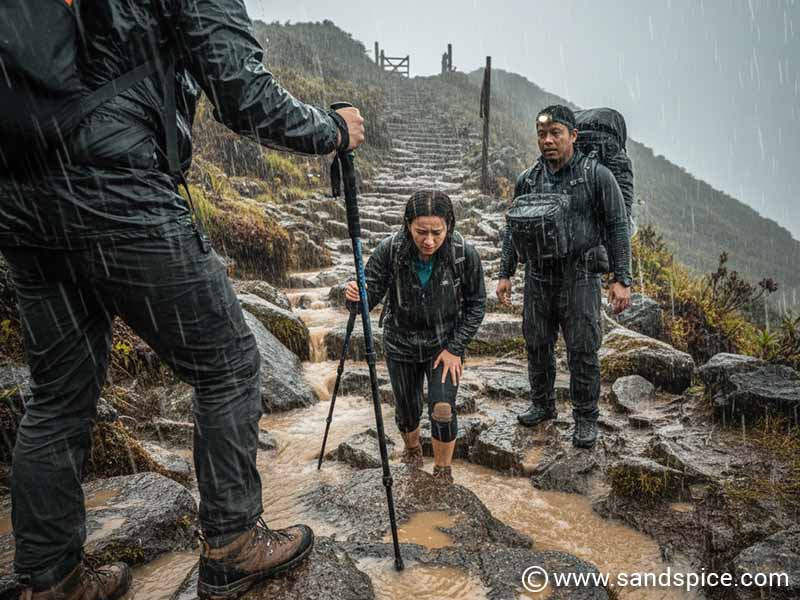
Climbers descending from basecamp
Our ordeal dragged on for six long, sodden hours amidst the torrential, tropical downpour. The track frequently disappeared beneath a flowing stream of muddy water, but mercifully, our boots provided the necessary traction.
We were grateful for the small things.
After a couple of kilometers I surrendered my backpack to Winston, which allowed me to regain a slightly faster rhythm.
The final, crowning indignity, when we were almost within spitting distance of the end, was the sight of yet more steep steps leading UP to the Timpohon Gate.
The mountain was truly getting the last laugh.
We finally limped through the gate, looking like a pair of elderly, bedraggled tramps who’d lost a fight with a washing machine.
We were soaked to the core, shivering, and Lena was deeply unhappy.
Post-Climb Conundrums 🌡️ A Sorry State of Affairs
We’d just made it in time to catch our pre-booked transfer back to Kota Kinabalu. Twenty minutes—that was all we had—for a lightning-fast change of clothes, and to collect our packed lunches and our climb achievement certificates.
We hobbled into the van, smelling faintly of desperation and damp cotton.
We were in a sorry state. Our upper and lower leg muscles were screaming in protest. Our toenails were sore and black. Our knees refused to bend enough to navigate any incline or decline, and our fingers were blistered from over-zealous use of the hiking poles.
The moment we stopped moving, our soaking clothes instantly began to chill us, so we kept the disposable raincoats on to retain body heat.
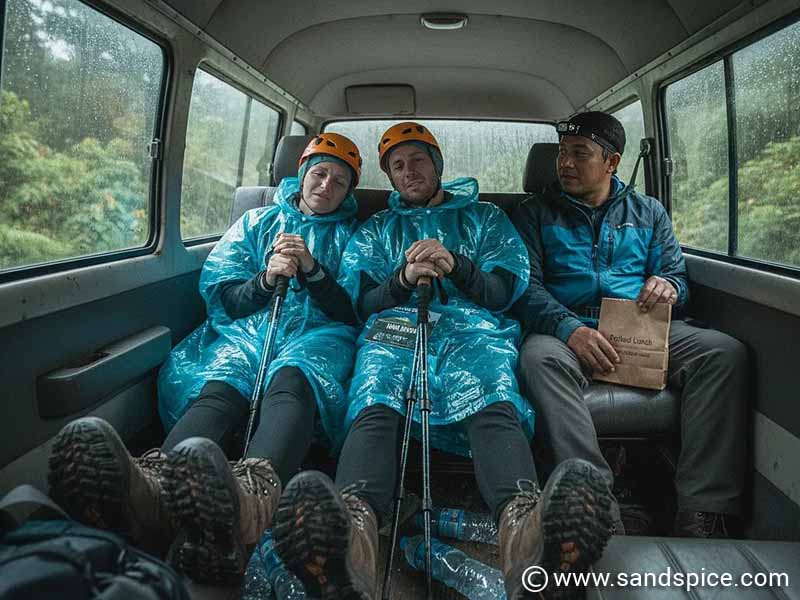
In the final two hours we’d also run critically low on water, leaving us deeply dehydrated.
We were in need of a proper wash. All we desired was a scalding hot shower, a warm, soft bed, and a very stiff drink.
But what, fundamentally, had we achieved?
Well, we’d climbed to over 4,000 metres, which was a personal best. It had been a long time since we’d pushed ourselves to such physical (and mental) limits.
The photographs, I can assure you, do not capture the brutal reality, but the views from the very topmost point of Malaysia and Borneo were dizzyingly, spectacularly impressive.
Yet, when we finally stood there, we were far more focused on finishing the climb than any feeling of profound accomplishment.
And no climb is ever finished until you’ve safely got back down again.
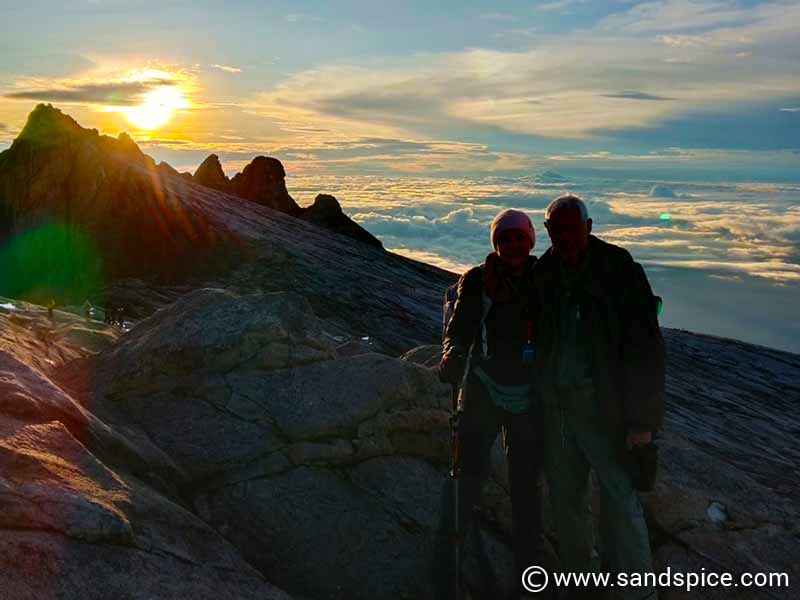
We did it all for this moment
A lesson, perhaps, was learned about aspirations and abilities. They don’t always go together.
The final word, however, must be a genuine commendation for Winston and Amazing Borneo Tours. From our initial contact to the final, damp conclusion of our adventure, their support and professionalism were flawless.
We later used them to arrange a scuba diving trip off Gaya Island (which, mercifully, involved little upward climbing).
Comparisons to Everest: While specific technical sections of Everest feature very high angles, especially near the summit, the average incline of the Mount Kinabalu climb is steeper than the Everest Base Camp (EBC) trek, and is a more consistent physical challenge in terms of gradient over a shorter timeframe.
Post-Trauma Recovery 🛀 The Shangri-La Rasa Ria
We were already acquainted with the Shangri-La Rasa Ria, but experiencing it after our Kinabalu trauma was an entirely different affair. It transforms from a pleasant coastal resort into a beacon of hedonistic salvation.
Imagine the scene: we arrive, looking like drowned rats who’ve fallen out of a charity bag—limping, smelling faintly of mountain goat, and utterly defeated. The staff, models of unflappable discretion, simply guide us toward the amenities, acknowledging our state of physical ruin with subtle, knowing nods.
The Recovery Protocol 🌊 A Necessary Plunge
The first order of business was, naturally, the bath. However, we focused our attention on the main pool area, which offered the requisite therapeutic soaking options.
Blackened toenail trauma
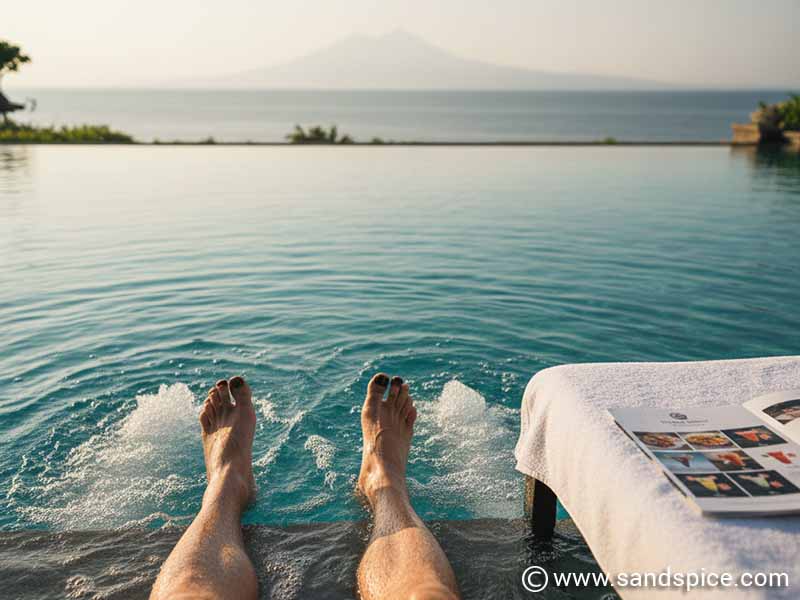
The Shangri-La Rasa Ria boasts an excellent, sprawling pool landscape. We commandeered the nearest available section that featured jets:
-
The Sensation: Submerging those battered, trembling calves into the jets, feeling the warmth begin to seep into the muscle fibres. It was a moment of wordless gratitude that we were no longer hanging onto a wet rope in the dark.
-
The View: From the poolside, we could gaze out over the South China Sea. Flat, blue, entirely devoid of any vertical inclination. A genuine tonic for the soul.
-
The Required Accessories: A fresh towel of excessive fluffiness and, critically, a menu from the poolside bar.
This was not mere relaxation; it was a mandatory physical reclamation. The hotel’s commitment to quiet, understated luxury was the perfect backdrop for our recovery.

What We Dragged Up the Mountain 🎒
Before any great feat of self-inflicted endurance, one must first engage in the ritualistic, slightly manic packing session. We had a list, of course—compiled from various sources and driven by the nagging fear of being unprepared. The resulting collection of gear was a pragmatic blend of absolute necessities and items that, in retrospect, were optimistic ballast.
This, then, is the catalogue of what we foolishly decided our poor backs and knees would be able to carry.
The Kit List: Essentials, Errors, & Edibles
The total weight of our bags felt heavier than the mountain itself by the time we reached the first shelter. Every single item had been meticulously reviewed, weighed, and then thrown in anyway. We were ready—or at least, our bulging rucksacks suggested we were.
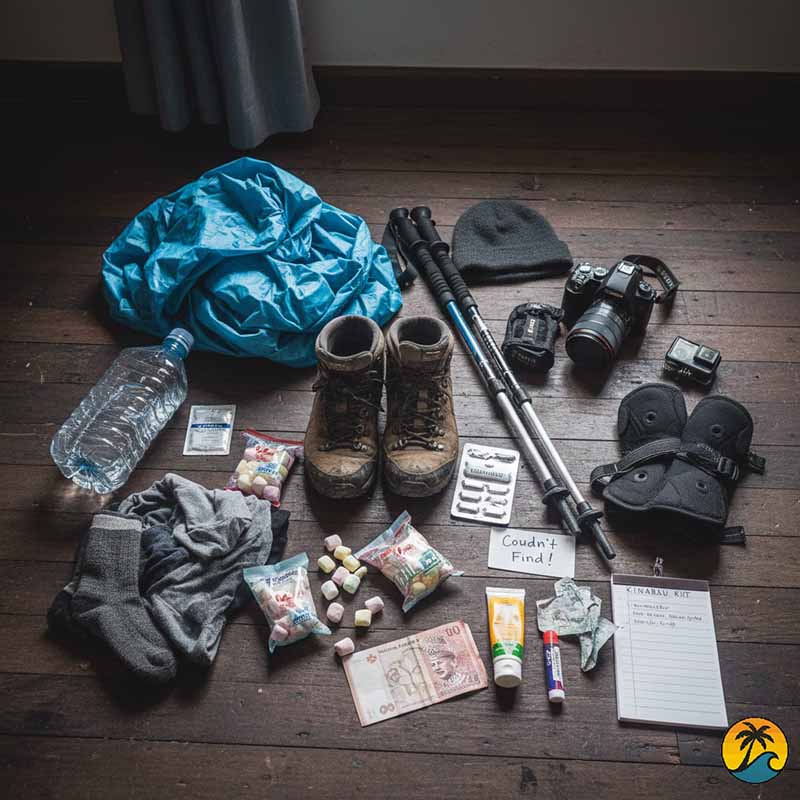
Our Kinabalu Kit
-
Hiking Boots (Well broken-in, thank goodness): The ‘sole’ reason we retained any dignity on the slippery rocks.
-
Hiking Poles: Acquired late, but proved to be our only true, load-bearing friends on the descent.
-
Plastic Water Bottles (1.5 L): To fill at various, slightly dubious mountain taps.
- Water Purification Tablets: Ensuring you don’t trade altitude sickness for dysentery.
-
Altitude Sickness Tablets (Diamox): The little white pills of hope (which we couldn’t find anywhere).
-
Blister Plasters: Essential for the inevitable foot revolt.
-
Pain Killers (Ibuprofen/Paracetamol): The real heroes of the entire operation.
-
Knee Supports: A desperate, last-minute attempt to convince our joints that they were still in their twenties.
-
Waterproof Raincoat (thin): Even with these, for staying dry you’ve got two hopes: Bob Hope and no hope.
-
Gloves & Hat (Beanie): For the brass monkey temperatures above 4,000 metres.
-
Suncream & Lipbalm: ‘Cause if the cold don’t get you, the sun surely will.
-
Headtorch (Doh!): Singular, because two would have been far too sensible.
-
Cameras: Because if you don’t document your suffering, did it even happen?
-
Sweets (Marshmallows): Pure, sugary energy—or just a slightly sticky distraction.
-
Spare Socks and T-shirts: The only things that’ll help you feel clean for your 36 hour trauma.
-
Cash: You’ll need for paying for stuff on the mountain (including tips).
Commemoration Cocktail 🍹 A Taste of Triumph
A mere gin and tonic simply won’t suffice to celebrate the conquest of Mount Kinabalu.
No, this required a concoction that is as dramatic, layered, and excessive as the mountain climb itself, yet infinitely more pleasant to consume.
We present to you:
🎯 The Kinabalu Knee-Saver 🎯
“An elaborate, multi-layered concoction to toast the wisdom of retreat and the sheer joy of remaining horizontal.”
This isn’t just a drink; it’s a structural masterpiece, mirroring the layers of the ascent we endured. It starts cool and smooth (our initial optimism), hits a powerful, complex centre (the actual climbing), and finishes with a strong, warm kick (the pain-killing euphoria of a hot bath and a good night’s sleep).
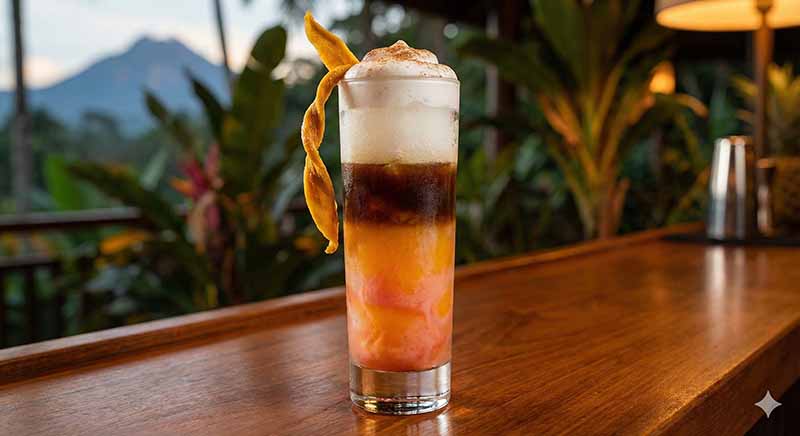
The Kinabalu Knee-Saver
Recipe and Components:
-
The Base Layer (The Summit): A frozen layer of Malaysian Tuak (local rice wine) blended with lime juice and a dash of white rum. Represents the freezing summit air and the clarity of dawn.
-
The Core Layer (The Ropes): A rich, dark layer of Pandan-Infused Dark Rum (infused for a complex, grassy, slightly dangerous flavour) mixed with Kahlúa and a small measure of Arak (to give it that ‘burn’ of exertion). Represents the dark, difficult, and slightly perilous rope sections.
-
The Mid-Layer (The Jungle): A vibrant, thick swirl of fresh Passion Fruit Purée and crushed Pink Ginger, providing a tart and tropical shock. Represents the sweaty, steamy, beautiful jungle environment.
-
The Final Touch (The Recovery): Topped with a generous foam of Coconut Cream whipped with Nutmeg and served with a dusting of Bornean Cinnamon. Represents the soft, warm comfort of our Shangri-La bed.
Presentation:
Served in a tall, narrow glass (mimicking the mountain’s height), layered to show the distinct ‘altitudes’. It must be garnished with a single, long, thin curl of Dried Mango, curved dramatically to look like a tiny, manageable rope.
Key Selling Points:
-
Complex Flavour Profile: A genuinely challenging yet ultimately rewarding taste experience.
-
Altitude-Inspired Layers: Sip through the journey, from the frozen peak to the warm, tropical base.
-
Zero Vertical Effort Required: All enjoyment is achieved with minimal muscle contraction.
-
Guaranteed Anti-Jelly-Leg Efficacy: May not cure, but will certainly distract.
Take a deep, non-altitude-induced breath, sip this triumphant tower of flavour, and know that you made the right choices.
Price:
A ridiculous amount
(it’s the Shangri-La, after all).
If you enjoyed Borneo’s Kinabalu Climb, take a look at Borneo’s Brutal Challenge. You may also like:
Spice up your inbox…

… with discounted hotel deals, cost-saving travel itineraries and SandSpice escapades! 😉